The Glass Mirror: From Polished Bronze to Silvering
Story context (click to hide this block) (click to show this block)
This paragraph may contain plot information.
A glass mirror imported from the West arrives at the imperial court and sparks immediate fascination: its value is described as extraordinary, and Maomao immediately takes an interest in how it is made. She realizes this object is not a simple toiletry accessory but a rare optical technology, unavailable locally. A few minutes later, she puts its properties to use to solve a criminal puzzle: by carefully positioning the mirror, she simulates the presence of a second person to guards watching from a distance, exploiting the reflection’s lateral inversion and the ambiguity of an embroidered pattern.
The subject in depth
From polished bronze to silvered glass
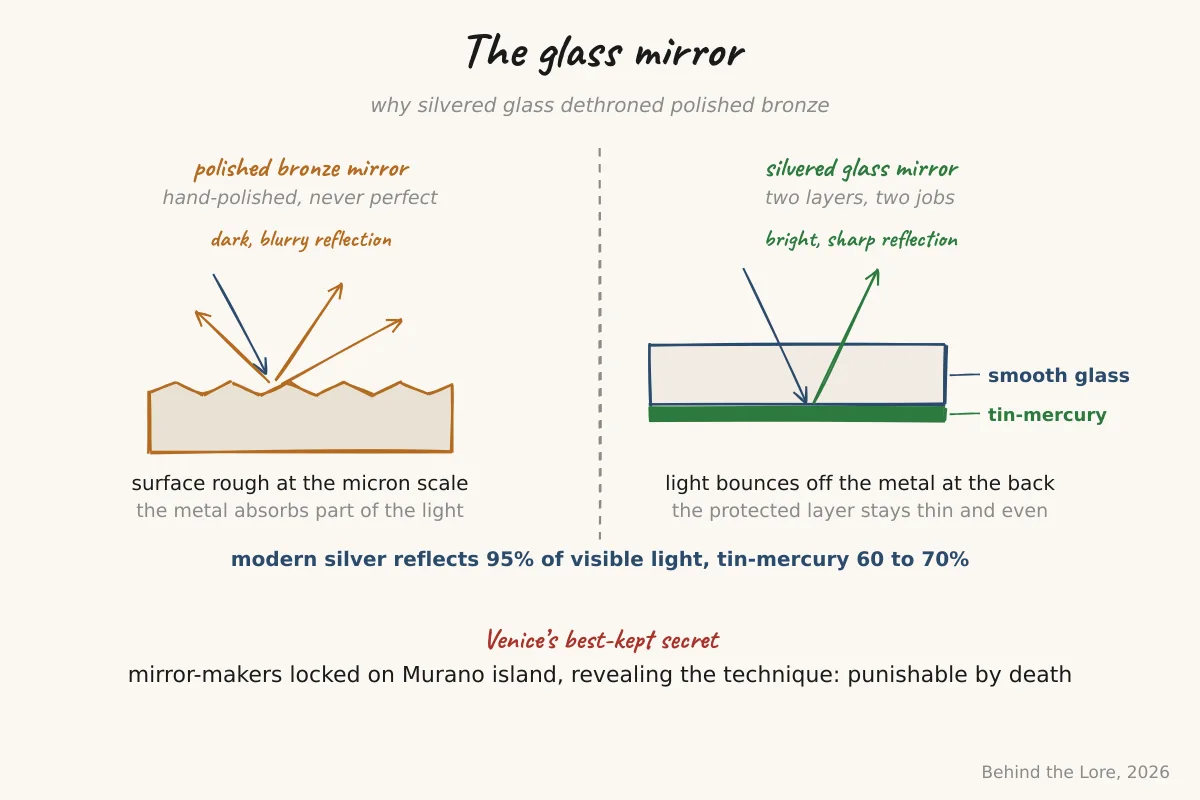
For millennia, the mirror par excellence was a polished metal surface: bronze, copper, or silver, depending on the patron’s wealth [Wikipedia] . These mirrors work because any highly polished metal reflects light, but they have two structural flaws. First, metal alloys can only be polished to a limited smoothness: at the micron scale, the surface remains irregular, scattering some of the light and blurring the reflection. Second, the metal itself absorbs a fraction of the light, darkening the image.
The solution, invented in the Middle East and developed in the eastern Mediterranean from the early Middle Ages onward, was to separate the two functions: entrust flatness to a plate of blown glass, and reflection to a very thin layer of metal deposited on the back. Glass, made by fusing silica and soda, can be blown into sheets far flatter than any forged metal [Wikipedia] . And the metal layer, protected by the glass and not exposed to wear, can be much thinner and more uniform than a hand-polished surface.
Silvering with tin and mercury
The most widespread technique for depositing this metal film was mercury-tin silvering. A sheet of tin foil was laid on a flat surface, liquid mercury was poured over it, and left to partially dissolve the tin into a semi-liquid amalgam. The glass plate was then placed on top, pressed to expel air bubbles, and gradually tilted to let the excess mercury run off [Wikipedia] . The remaining amalgam clung to the back of the glass and, on cooling, formed a dense, bright, perfectly uniform tin-mercury film.
The optical result was spectacular compared to polished bronze: the tin-mercury alloy reflects a far greater proportion of light, and since the glass surface is nearly perfectly flat, the reflection is undistorted. The image quality is beyond comparison with any hand-polished metal surface.
Venice and the mirror-makers’ secret
It was in Venice, from the 16th century onward, that the manufacture of silvered glass mirrors reached its industrial peak. Glassmakers and mirror-makers were confined to the island of Murano and bound by a draconian state secret: leaving the island without authorization was a serious offense, and revealing the techniques abroad was punishable by death. This engineered scarcity explains why Venetian mirrors fetched, across Europe and Asia, prices comparable to top-tier works of art.
Even so, the secret eventually leaked, notably through the France of Louis XIV, who recruited Venetian mirror-makers to supply the Royal Glassworks Manufactory (the future Saint-Gobain). In parts of East Asia where glass-blowing was not practiced at scale, such a mirror remained an object of singular prestige, imported via long-distance trade routes, a detail the story portrays with solid historical accuracy.
Silvering: the modern technique
Mercury-based silvering had one major drawback: mercury is toxic, and the workers who handled it often died young. In the 19th century, the chemist Justus von Liebig developed a replacement process: the chemical reduction of a silver salt (silver nitrate) by an organic reducing agent (sugar, formaldehyde) in aqueous solution. Metallic silver then deposits as a uniform film on the glass, without mercury. This technique, known as silvering, is the one still used in every modern mirror today. Silver reflects about 95% of visible light, compared to 60–70% for tin-mercury, which explains the superior quality of contemporary mirrors.
Going further
Sources
Published on
Keep investigating
Auto-suggested from shared concepts, disciplines, episodes, or characters.
Mercury
In The Apothecary Diaries, quicksilver goes into a court poison. We explain mercury, its toxicity, and the immortality elixirs that killed emperors.
Orpiment and Arsenic
In The Apothecary Diaries, a yellow pigment poisons slowly. We explain orpiment, arsenic, and the chronic poisoning of court painters.
Bear Bile
Why did bear bile, a traditional TCM remedy, lead to a modern drug? UDCA dissolves gallstones and treats the liver.
Black Powder
In The Apothecary Diaries, Maomao states the exact formula for black powder. We explain the role of each ingredient, the reaction, and the rotten-egg smell.
Elixirs of Immortality
Several Chinese emperors were killed by elixirs meant to make them immortal. Waidan alchemy, cinnabar, mercury, and arsenic explained.