Morse code explained through Dr Stone
Story context (click to hide this block) (click to show this block)
This paragraph may contain plot information.
In the middle of the war of science, Senku needs to communicate fast and discreetly, sometimes without being able to speak. Morse code offers him an elegant solution: a language of short and long signals that can be sent through a ringtone, a flash of light, or the humblest electrical line. The content of the message no longer depends on the channel, only on the rhythm of the pulses, which makes communication both robust and hard to intercept for anyone who doesn’t know the code.
The subject in depth
Morse code is an information-encoding system [Wikipedia] . Its founding idea is to represent each letter, digit, or punctuation mark not by a single symbol, but by a combination of only two elements: a short signal, the dot, and a signal three times longer, the dash. Between the elements of a single letter comes a brief silence, between letters a longer silence, and between words a longer silence still. Everything therefore rests on the contrast between presence and absence of signal, and on duration.
The trick that makes Morse efficient is the assignment of codes according to letter frequency. The most common letters receive the shortest codes: in international Morse, E is written as a single dot, T as a single dash, while a rare letter gets a longer combination. This principle, giving the briefest symbols to the most frequent characters, anticipates a central idea of modern telecommunications: information compression.
Morse’s great strength is its independence from the physical medium. Since it only requires two distinguishable states, it can ride on any channel capable of producing pulses of different durations. Historically, that was electric current on a wire: the telegraph, the first great electrical telecommunication, transmitted these dots and dashes as pulses of current [Wikipedia] . But the same message can just as well be sent by a lamp switched on and off, by knocks, by a whistle, or by a telephone’s ring [Wikipedia] . The receiver needs only one sense (hearing or sight) and the lookup table to reconstruct the text.
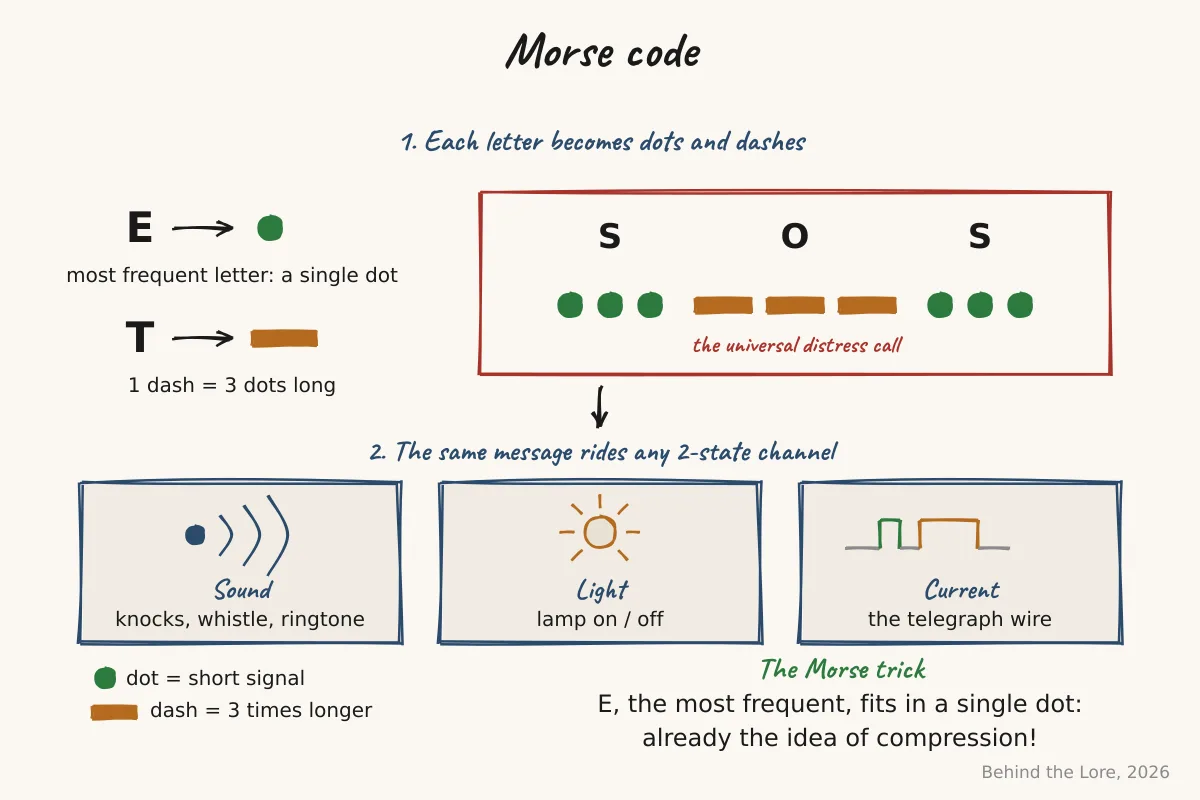
This robustness explains Morse’s longevity: even in badly degraded conditions, where the voice becomes inaudible, a succession of dots and dashes remains perceptible and decipherable.
Going further
- Coming soon: The magneto telephone
- Discipline: Physics
- Discipline: History of science
Sources
Published on
Going further
Auto-suggested from shared concepts, disciplines, episodes, or characters.
Aristotelian physics
Rafal cites Aristotle to prove the Earth is at the center in Orb. We explain Aristotelian physics and its link to geocentrism.
Black Powder
Senku makes gunpowder in Dr Stone. We explain its composition (saltpeter, charcoal, sulfur), the chemical reaction, and its history.
Dynamite
How did Nobel tame nitroglycerin? We explain dynamite, absorption into kieselguhr, and the link with the Nobel Prize.
Papermaking
Senku makes paper in Dr Stone. We explain how alkaline cooking frees cellulose fibers by dissolving lignin, then how the sheet is formed.
The Magic Mirror
In The Apothecary Diaries, a bronze mirror projects its engravings in reflected light. We explain the real physics behind this so-called magic mirror.