The Magic Mirror: bronze and ancient optics
Story context (click to hide this block) (click to show this block)
This paragraph may contain plot information.
Maomao is called to get to the bottom of a “dancing ghost” terrorizing Lady Lishu’s chambers. She finds a bronze mirror, turns its back toward the moonlight, and the image of the engravings is projected onto the curtain, animated by steam rising from the floor. She names the object without hesitation: a “magic mirror, also called a light-transmitting mirror.” In doing so, she turns an apparition into a physical phenomenon, and an object of superstition into a piece of evidence.
The subject in depth
The Chinese magic mirror, known as the tou guang jian, is a bronze disc with one face polished like an ordinary mirror and the other bearing bas-relief engravings: inscriptions, geometric figures, dragons, or floral motifs. In normal light, held at arm’s length, it behaves like an ordinary opaque mirror [Wikipedia] . But if a beam of sunlight or a concentrated light source is directed at it, the image reflected onto a wall faithfully reproduces the engravings on the back. The object appears transparent even though it’s solid metal, hence its name: a mirror that lets light pass through.
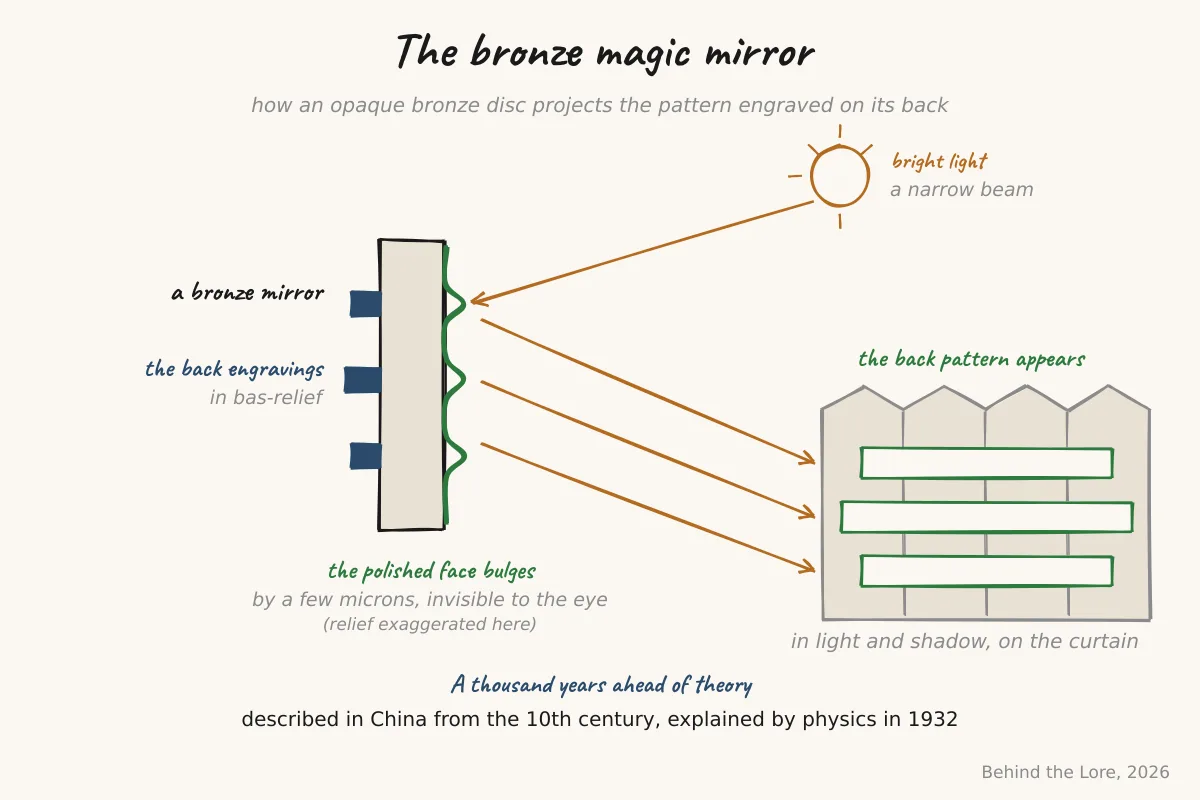
The key lies in the polishing. To achieve a perfectly reflective face, the craftsman rubs the bronze disc with a progressively finer abrasive, pressing evenly across the whole surface. But bronze is a copper-tin alloy whose thickness isn’t perfectly uniform: the areas behind an engraved relief are slightly thicker than the hollow areas. As the craftsman polishes and presses, the thinner areas give a little more than the thicker ones. The result is that the polished face, seen in cross-section, is not perfectly flat: it carries micro-bulges that correspond exactly to the relief on the back, with elevations on the order of a few microns, invisible to the eye and even imperceptible to the touch.
These micro-curves act like an array of tiny lenses, or tiny concave and convex mirrors. A slightly bulging zone scatters the reflected light and therefore appears less bright on the wall; a slightly recessed zone converges it and forms a brighter patch. The difference in light intensity between neighboring zones is too small to be perceived in diffuse ambient light, but under a narrow, intense beam it becomes visible [Wikipedia] . The pattern on the back, translated into a thickness map, is thus projected in light and shadow onto any surface placed in front of it.
This mechanism wasn’t elucidated by modern physics until 1932, when William Bragg published an explanation in the journal Nature, building on earlier work by Robert Wood dating from 1902. Yet magic mirrors are documented in China from at least the 10th century onward, and comparable objects have been found in Japan. For centuries, even the European physicists who examined them couldn’t understand how a clearly opaque surface could project an image. The answer lay neither in the materials nor in any secret treatment: it lay in the microscopic geometry of a seemingly smooth surface.
Going further
Sources
Published on
Keep investigating
Auto-suggested from shared concepts, disciplines, episodes, or characters.
Mercury
In The Apothecary Diaries, quicksilver goes into a court poison. We explain mercury, its toxicity, and the immortality elixirs that killed emperors.
Orpiment and Arsenic
In The Apothecary Diaries, a yellow pigment poisons slowly. We explain orpiment, arsenic, and the chronic poisoning of court painters.
Carbon Monoxide
In The Apothecary Diaries, embers bring guests down at a party. We explain carbon monoxide, why it suffocates without warning, and the right thing to do.
Nerve Damage and Paralysis
In The Apothecary Diaries, a beating leaves a man paralyzed. We explain how nerve damage cuts off muscle control and why recovery is uncertain.
Aristotelian physics
Rafal cites Aristotle to prove the Earth is at the center in Orb. We explain Aristotelian physics and its link to geocentrism.